Knowing What a Rainbow Looks Like Because You Have Seen a Rainbow Is an Example of a Concept
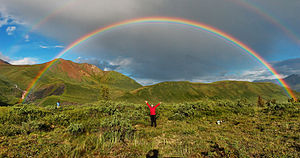
Double rainbow and supernumerary rainbows on the inside of the master arc. The shadow of the photographer's head on the bottom marks the eye of the rainbow circumvolve (antisolar indicate).
A rainbow is a meteorological miracle that is caused by reflection, refraction and dispersion of calorie-free in water droplets resulting in a spectrum of light actualization in the sky. Information technology takes the form of a multicoloured circular arc. Rainbows caused by sunlight e'er announced in the section of sky direct opposite the Sun.
Rainbows can exist full circles. Nevertheless, the observer normally sees just an arc formed by illuminated droplets above the ground,[1] and centered on a line from the Sunday to the observer's heart.
In a primary rainbow, the arc shows red on the outer part and violet on the inner side. This rainbow is caused past lite being refracted when inbound a droplet of h2o, so reflected within on the back of the droplet and refracted again when leaving it.
In a double rainbow, a second arc is seen exterior the master arc, and has the guild of its colours reversed, with red on the inner side of the arc. This is caused by the light beingness reflected twice on the inside of the droplet before leaving information technology.
Overview
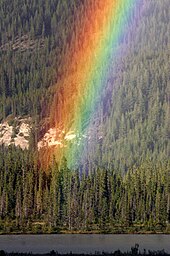
A rainbow is non located at a specific altitude from the observer, but comes from an optical illusion caused by any h2o droplets viewed from a certain angle relative to a light source. Thus, a rainbow is not an object and cannot be physically approached. Indeed, it is incommunicable for an observer to run across a rainbow from water droplets at any angle other than the customary 1 of 42 degrees from the direction opposite the light source. Fifty-fifty if an observer sees another observer who seems "nether" or "at the end of" a rainbow, the 2d observer will see a different rainbow—farther off—at the aforementioned bending as seen by the first observer.
Rainbows span a continuous spectrum of colours. Any distinct bands perceived are an artefact of human color vision, and no banding of any type is seen in a black-and-white photo of a rainbow, only a smooth gradation of intensity to a maximum, then fading towards the other side. For colours seen by the man eye, the most commonly cited and remembered sequence is Isaac Newton's sevenfold red, orange, yellowish, green, blue, indigo and violet,[ii] [a] remembered by the mnemonic Richard Of York Gave Battle In Vain (ROYGBIV). The initialism is sometimes referred to in reverse society, equally VIBGYOR.
Rainbows can be caused by many forms of airborne water. These include not only pelting, but likewise mist, spray, and airborne dew.
Visibility
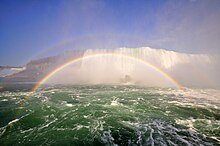
Rainbows can form in the spray of a waterfall (called spray bows)

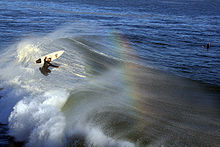
Rainbows may form in the spray created by waves
Rainbows can exist observed whenever at that place are h2o drops in the air and sunlight shining from backside the observer at a low altitude angle. Because of this, rainbows are usually seen in the western sky during the morning and in the eastern heaven during the early evening. The most spectacular rainbow displays happen when half the heaven is still dark with raining clouds and the observer is at a spot with clear sky in the direction of the Lord's day. The result is a luminous rainbow that contrasts with the darkened background. During such good visibility conditions, the larger simply fainter secondary rainbow is oft visible. It appears about 10° outside of the chief rainbow, with inverse lodge of colours.
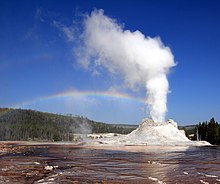
The rainbow upshot is likewise normally seen near waterfalls or fountains. In addition, the effect can be artificially created by dispersing water droplets into the air during a sunny twenty-four hours. Rarely, a moonbow, lunar rainbow or nighttime rainbow, can be seen on strongly moonlit nights. Equally human visual perception for colour is poor in depression calorie-free, moonbows are often perceived to be white.[iv]
It is difficult to photograph the complete semicircle of a rainbow in 1 frame, every bit this would require an angle of view of 84°. For a 35 mm camera, a wide-bending lens with a focal length of nineteen mm or less would be required. At present that software for stitching several images into a panorama is available, images of the unabridged arc and fifty-fifty secondary arcs tin can be created fairly hands from a series of overlapping frames.
From above the Earth such as in an aeroplane, it is sometimes possible to see a rainbow as a total circle. This phenomenon can be confused with the glory phenomenon, simply a glory is normally much smaller, covering only v–20°.
The sky inside a primary rainbow is brighter than the sky outside of the bow. This is because each raindrop is a sphere and information technology scatters low-cal over an entire circular disc in the sky. The radius of the disc depends on the wavelength of light, with red lite being scattered over a larger angle than blue light. Over most of the disc, scattered light at all wavelengths overlaps, resulting in white light which brightens the sky. At the edge, the wavelength dependence of the handful gives rise to the rainbow.[5]
Low-cal of master rainbow arc is 96% polarised tangential to the arch.[vi] Light of second arc is xc% polarised.
Number of colours in a spectrum or a rainbow
A spectrum obtained using a glass prism and a betoken source is a continuum of wavelengths without bands. The number of colours that the man eye is able to distinguish in a spectrum is in the order of 100.[7] Accordingly, the Munsell colour organization (a 20th-century system for numerically describing colours, based on equal steps for human visual perception) distinguishes 100 hues. The apparent discreteness of master colours is an artefact of homo perception and the exact number of primary colours is a somewhat arbitrary choice.
Newton, who admitted his optics were not very critical in distinguishing colours,[8] originally (1672) divided the spectrum into v main colours: red, xanthous, dark-green, blue and violet. Later he included orange and indigo, giving 7 principal colours by analogy to the number of notes in a musical calibration.[2] [b] [ix] Newton chose to split up the visible spectrum into seven colours out of a belief derived from the beliefs of the aboriginal Greek sophists, who idea in that location was a connectedness between the colours, the musical notes, the known objects in the Solar System, and the days of the week.[ten] [11] [12] Scholars have noted that what Newton regarded at the fourth dimension as "blue" would today be regarded as cyan, and what Newton called "indigo" would today be considered blue.[iii]

Rainbow (middle: existent, lesser: computed) compared to truthful spectrum (top): unsaturated colours and dissimilar color contour
| Newton's first colours | Red | Xanthous | Light-green | Blue | Violet | ||
| Newton's later colours | Ruddy | Orange | Yellow | Green | Blue | Indigo | Violet |
| Modern colours | Red | Orange | Yellow | Dark-green | Cyan | Blueish | Violet |
The colour pattern of a rainbow is different from a spectrum, and the colours are less saturated. In that location is spectral smearing in a rainbow attributable to the fact that for whatsoever particular wavelength, at that place is a distribution of exit angles, rather than a single unvarying angle.[13] In add-on, a rainbow is a blurred version of the bow obtained from a point source, because the deejay diameter of the sun (0.5°) cannot be neglected compared to the width of a rainbow (2°). Further cherry-red of the kickoff supplementary rainbow overlaps the violet of the primary rainbow, so rather than the final colour existence a variant of spectral violet, information technology is really a purple. The number of colour bands of a rainbow may therefore exist dissimilar from the number of bands in a spectrum, specially if the droplets are particularly large or modest. Therefore, the number of colours of a rainbow is variable. If, still, the word rainbow is used inaccurately to mean spectrum, it is the number of main colours in the spectrum.
The question of whether anybody sees seven colours in a rainbow is related to the thought of linguistic relativity. Suggestions take been fabricated that there is universality in the way that a rainbow is perceived.[14] [15] However, more recent research suggests that the number of singled-out colours observed and what these are chosen depend on the linguistic communication that ane uses, with people whose language has fewer colour words seeing fewer discrete colour bands.[16]
Explanation

Light rays enter a raindrop from one direction (typically a straight line from the Sun), reflect off the dorsum of the raindrop, and fan out every bit they exit the raindrop. The light leaving the rainbow is spread over a broad angle, with a maximum intensity at the angles 40.89–42°. (Notation: Between two and 100% of the lite is reflected at each of the three surfaces encountered, depending on the angle of incidence. This diagram only shows the paths relevant to the rainbow.)

White light separates into dissimilar colours on entering the raindrop due to dispersion, causing red light to be refracted less than blue low-cal.
When sunlight encounters a raindrop, office of the low-cal is reflected and the remainder enters the raindrop. The low-cal is refracted at the surface of the raindrop. When this light hits the back of the raindrop, some of it is reflected off the back. When the internally reflected calorie-free reaches the surface once again, once more some is internally reflected and some is refracted as it exits the drop. (The lite that reflects off the drop, exits from the back, or continues to bounciness around inside the driblet afterwards the 2nd encounter with the surface, is not relevant to the formation of the primary rainbow.) The overall consequence is that role of the incoming calorie-free is reflected back over the range of 0° to 42°, with the most intense lite at 42°.[17] This angle is independent of the size of the drop, simply does depend on its refractive index. Seawater has a higher refractive index than rain water, so the radius of a "rainbow" in ocean spray is smaller than a true rainbow. This is visible to the naked eye past a misalignment of these bows.[xviii]
The reason the returning light is most intense at about 42° is that this is a turning point – light hitting the outermost ring of the drib gets returned at less than 42°, as does the light hitting the drib nearer to its centre. There is a circular band of light that all gets returned right around 42°. If the Lord's day were a laser emitting parallel, monochromatic rays, then the luminance (brightness) of the bow would tend toward infinity at this angle (ignoring interference furnishings). (Run into Caustic (optics).) Merely since the Dominicus'due south luminance is finite and its rays are non all parallel (it covers most half a degree of the sky) the luminance does non become to infinity. Furthermore, the corporeality past which light is refracted depends upon its wavelength, and hence its colour. This result is called dispersion. Blue light (shorter wavelength) is refracted at a greater angle than crimson light, only due to the reflection of light rays from the back of the droplet, the blue light emerges from the droplet at a smaller angle to the original incident white lite ray than the red light. Due to this angle, blue is seen on the inside of the arc of the primary rainbow, and crimson on the outside. The result of this is not but to requite different colours to different parts of the rainbow, but also to diminish the brightness. (A "rainbow" formed by droplets of a liquid with no dispersion would be white, but brighter than a normal rainbow.)
The light at the dorsum of the raindrop does not undergo total internal reflection, and some light does emerge from the back. However, low-cal coming out the back of the raindrop does non create a rainbow between the observer and the Sun because spectra emitted from the back of the raindrop do not have a maximum of intensity, as the other visible rainbows practice, and thus the colours alloy together rather than forming a rainbow.[xix]
A rainbow does not be at i particular location. Many rainbows exist; yet, simply one can be seen depending on the particular observer's viewpoint as droplets of light illuminated past the sun. All raindrops refract and reverberate the sunlight in the aforementioned manner, but only the light from some raindrops reaches the observer'southward eye. This calorie-free is what constitutes the rainbow for that observer. The whole system composed by the Sun's rays, the observer'south head, and the (spherical) water drops has an axial symmetry effectually the centrality through the observer'southward head and parallel to the Sun's rays. The rainbow is curved considering the fix of all the raindrops that accept the correct angle between the observer, the drop, and the Sunday, lie on a cone pointing at the sun with the observer at the tip. The base of operations of the cone forms a circle at an angle of 40–42° to the line between the observer'south head and their shadow but 50% or more of the circle is below the horizon, unless the observer is sufficiently far above the world'southward surface to see it all, for example in an airplane (see below).[20] [21] Alternatively, an observer with the right vantage indicate may see the full circumvolve in a fountain or waterfall spray.[22]
Mathematical derivation

It is possible to decide the perceived angle which the rainbow subtends as follows.[23]
Given a spherical raindrop, and defining the perceived bending of the rainbow as 2φ , and the angle of the internal reflection as 2β , and so the angle of incidence of the Sunday'southward rays with respect to the drib's surface normal is 2β − φ . Since the angle of refraction is β , Snell'due south law gives us
- sin(2β − φ) = n sin β ,
where n = 1.333 is the refractive index of water. Solving for φ , we become
- φ = 2β − arcsin(n sin β).
The rainbow will occur where the angle φ is maximum with respect to the angle β . Therefore, from calculus, we can fix dφ/dβ = 0, and solve for β , which yields
- .

Substituting back into the earlier equation for φ yields 2φ max ≈ 42° every bit the radius angle of the rainbow.
For red calorie-free (wavelength 750nm, due north = one.330 based on the dispersion relation of water), the radius angle is 42.5°; for blue light (wavelength 350nm, n = i.343), the radius angle is 40.6°.
Variations
Double rainbows
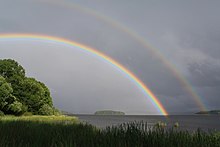
Double rainbow with Alexander'southward ring visible between the primary and secondary bows. Also note the pronounced supernumerary bows inside the main bow.

The primary rainbow is "twinned."

Physics of a primary and secondary rainbow and Alexander'southward dark ring[24] (The image of the sun in the motion-picture show is only conventional; all rays are parallel to the axis of the rainbow's cone)
A secondary rainbow, at a greater bending than the primary rainbow, is ofttimes visible. The term double rainbow is used when both the main and secondary rainbows are visible. In theory, all rainbows are double rainbows, but since the secondary bow is always fainter than the primary, it may be too weak to spot in practice.
Secondary rainbows are caused by a double reflection of sunlight inside the water aerosol. Technically the secondary bow is centred on the sun itself, merely since its angular size is more than 90° (nigh 127° for violet to 130° for red), information technology is seen on the aforementioned side of the heaven as the master rainbow, nearly ten° outside it at an apparent bending of 50–53°. As a result of the "inside" of the secondary bow being "upwards" to the observer, the colours appear reversed compared to those of the main bow.
The secondary rainbow is fainter than the primary because more light escapes from two reflections compared to one and considering the rainbow itself is spread over a greater area of the sky. Each rainbow reflects white light inside its coloured bands, but that is "down" for the primary and "up" for the secondary.[25] The dark area of unlit sky lying betwixt the main and secondary bows is called Alexander's band, after Alexander of Aphrodisias who first described information technology.[26]
Twinned rainbow
Different a double rainbow that consists of two carve up and concentric rainbow arcs, the very rare twinned rainbow appears as ii rainbow arcs that split from a unmarried base.[27] The colours in the second bow, rather than reversing as in a secondary rainbow, appear in the same society every bit the primary rainbow. A "normal" secondary rainbow may be present also. Twinned rainbows tin can look similar to, simply should not be confused with supernumerary bands. The two phenomena may be told apart by their difference in colour profile: supernumerary bands consist of subdued pastel hues (mainly pinkish, purple and green), while the twinned rainbow shows the same spectrum every bit a regular rainbow. The cause of a twinned rainbow is the combination of different sizes of water drops falling from the sky. Due to air resistance, raindrops flatten as they autumn, and flattening is more prominent in larger water drops. When two pelting showers with unlike-sized raindrops combine, they each produce slightly different rainbows which may combine and form a twinned rainbow.[28] A numerical ray tracing study showed that a twinned rainbow on a photo could be explained by a mixture of 0.forty and 0.45 mm droplets. That small difference in droplet size resulted in a small difference in flattening of the droplet shape, and a large departure in flattening of the rainbow superlative.[29]

Meanwhile, the even rarer case of a rainbow split into three branches was observed and photographed in nature.[30]
Full-circle rainbow
In theory, every rainbow is a circumvolve, but from the ground, usually merely its upper half tin can exist seen. Since the rainbow's centre is diametrically opposed to the Sun's position in the heaven, more of the circle comes into view as the sun approaches the horizon, meaning that the largest section of the circle normally seen is about l% during sunset or sunrise. Viewing the rainbow's lower one-half requires the presence of water droplets below the observer's horizon, equally well as sunlight that is able to reach them. These requirements are not usually met when the viewer is at basis level, either because droplets are absent in the required position, or because the sunlight is obstructed past the landscape behind the observer. From a high viewpoint such as a high edifice or an aircraft, even so, the requirements tin be met and the full-circle rainbow tin can be seen.[31] [32] Like a partial rainbow, the circular rainbow can have a secondary bow or supernumerary bows equally well.[33] Information technology is possible to produce the full circle when standing on the footing, for case by spraying a water mist from a garden hose while facing away from the dominicus.[34]
A round rainbow should not exist confused with the glory, which is much smaller in bore and is created by different optical processes. In the right circumstances, a glory and a (circular) rainbow or fog bow can occur together. Another atmospheric phenomenon that may exist mistaken for a "circular rainbow" is the 22° halo, which is caused by ice crystals rather than liquid water droplets, and is located around the Sun (or Moon), non reverse it.
Supernumerary rainbows

High dynamic range photo of a rainbow with additional supernumerary bands inside the primary bow
In certain circumstances, 1 or several narrow, faintly coloured bands can be seen bordering the violet edge of a rainbow; i.east., inside the primary bow or, much more rarely, outside the secondary. These extra bands are called supernumerary rainbows or supernumerary bands; together with the rainbow itself the phenomenon is also known every bit a stacker rainbow. The supernumerary bows are slightly detached from the primary bow, get successively fainter along with their distance from it, and take pastel colours (consisting mainly of pinkish, purple and dark-green hues) rather than the usual spectrum blueprint.[35] The result becomes apparent when water droplets are involved that have a diameter of nigh ane mm or less; the smaller the droplets are, the broader the supernumerary bands go, and the less saturated their colours.[36] Due to their origin in small droplets, supernumerary bands tend to exist particularly prominent in fogbows.[37]
Supernumerary rainbows cannot exist explained using classical geometric optics. The alternating faint bands are caused by interference between rays of light following slightly different paths with slightly varying lengths within the raindrops. Some rays are in phase, reinforcing each other through constructive interference, creating a bright ring; others are out of stage past upward to half a wavelength, cancelling each other out through subversive interference, and creating a gap. Given the different angles of refraction for rays of different colours, the patterns of interference are slightly dissimilar for rays of different colours, so each bright band is differentiated in colour, creating a miniature rainbow. Supernumerary rainbows are clearest when raindrops are pocket-sized and of uniform size. The very existence of supernumerary rainbows was historically a get-go indication of the wave nature of light, and the first explanation was provided by Thomas Young in 1804.[38]
Reflected rainbow, reflection rainbow

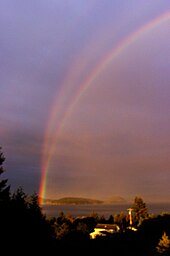
Reflection rainbow (top) and normal rainbow (bottom) at sunset
When a rainbow appears above a body of h2o, two complementary mirror bows may be seen below and above the horizon, originating from different light paths. Their names are slightly different.
A reflected rainbow may appear in the water surface below the horizon.[39] The sunlight is commencement deflected by the raindrops, and then reflected off the torso of water, before reaching the observer. The reflected rainbow is frequently visible, at to the lowest degree partially, even in small puddles.
A reflection rainbow may be produced where sunlight reflects off a body of water earlier reaching the raindrops, if the h2o body is large, quiet over its entire surface, and close to the rain curtain. The reflection rainbow appears above the horizon. It intersects the normal rainbow at the horizon, and its arc reaches higher in the sky, with its centre equally high to a higher place the horizon as the normal rainbow'due south center is below information technology. Reflection bows are usually brightest when the sun is low because at that fourth dimension its light is most strongly reflected from h2o surfaces. As the sunday gets lower the normal and reflection bows are drawn closer together. Due to the combination of requirements, a reflection rainbow is rarely visible.
Upward to eight split bows may be distinguished if the reflected and reflection rainbows happen to occur simultaneously: The normal (non-reflection) main and secondary bows above the horizon (i, 2) with their reflected counterparts below it (3, iv), and the reflection primary and secondary bows above the horizon (5, 6) with their reflected counterparts below it (7, 8).[40] [41]
Monochrome rainbow

Unenhanced photograph of a red (monochrome) rainbow
Occasionally a shower may happen at sunrise or sunset, where the shorter wavelengths like blue and green have been scattered and essentially removed from the spectrum. Further scattering may occur due to the rain, and the result tin be the rare and dramatic monochrome or blood-red rainbow. [42]
Higher-society rainbows
In addition to the common main and secondary rainbows, it is also possible for rainbows of college orders to grade. The order of a rainbow is determined by the number of light reflections within the water droplets that create information technology: One reflection results in the commencement-order or primary rainbow; 2 reflections create the second-club or secondary rainbow. More internal reflections cause bows of college orders—theoretically unto infinity.[43] Equally more and more calorie-free is lost with each internal reflection, however, each subsequent bow becomes progressively dimmer and therefore increasingly difficult to spot. An additional challenge in observing the third-club (or tertiary) and fourth-gild (fourth) rainbows is their location in the management of the sun (nearly twoscore° and 45° from the sunday, respectively), causing them to go drowned in its glare.[44]
For these reasons, naturally occurring rainbows of an club higher than ii are rarely visible to the naked center. Nevertheless, sightings of the tertiary-lodge bow in nature have been reported, and in 2011 it was photographed definitively for the first time.[45] [46] Shortly after, the fourth-club rainbow was photographed as well,[47] [48] and in 2014 the offset e'er pictures of the 5th-guild (or quinary) rainbow, located in between the primary and secondary bows, were published.[49] In a laboratory setting, it is possible to create bows of much higher orders. Felix Billet (1808–1882) depicted angular positions up to the 19th-gild rainbow, a pattern he chosen a "rose of rainbows".[50] [51] [52] In the laboratory, information technology is possible to notice higher-order rainbows by using extremely vivid and well collimated light produced by lasers. Up to the 200th-order rainbow was reported by Ng et al. in 1998 using a like method but an argon ion laser beam.[53]
3rd and quaternary rainbows should not be dislocated with "triple" and "quadruple" rainbows—terms sometimes erroneously used to refer to the—much more mutual—supernumerary bows and reflection rainbows.
Rainbows under moonlight
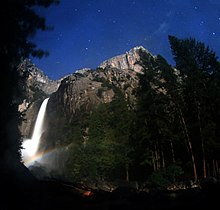
Similar most atmospheric optical phenomena, rainbows tin exist caused past calorie-free from the Sun, but also from the Moon. In case of the latter, the rainbow is referred to as a lunar rainbow or moonbow. They are much dimmer and rarer than solar rainbows, requiring the Moon to be near-full in order for them to be seen. For the same reason, moonbows are often perceived every bit white and may be thought of as monochrome. The full spectrum is present, however, only the human middle is not ordinarily sensitive plenty to encounter the colours. Long exposure photographs volition sometimes prove the colour in this type of rainbow.[54]
Fogbow

Fogbows form in the same way as rainbows, but they are formed by much smaller cloud and fog aerosol that diffract light extensively. They are almost white with faint reds on the exterior and dejection inside; often one or more broad supernumerary bands can be discerned inside the inner edge. The colours are dim because the bow in each colour is very broad and the colours overlap. Fogbows are commonly seen over water when air in contact with the libation water is chilled, but they tin be found anywhere if the fog is thin enough for the sun to smooth through and the sun is fairly bright. They are very large—almost as large as a rainbow and much broader. They sometimes appear with a glory at the bow's centre.[55]
Fog bows should non be dislocated with ice halos, which are very common effectually the world and visible much more frequently than rainbows (of whatsoever order),[56] all the same are unrelated to rainbows.
Sleetbow

Monochrome sleetbow captured during the early on morning time on Jan vii, 2016 in Valparaiso, Indiana.
A sleetbow forms in the same way equally a typical rainbow, with the exception that it occurs when light passes through falling sleet (ice pellets) instead of liquid water. As lite passes through the sleet, the calorie-free is refracted causing the rare phenomena. These have been documented beyond Usa with the earliest publicly documented and photographed sleetbow being seen in Richmond, Virginia on December 21, 2012.[57] Just like regular rainbows, these tin can also come in various forms, with a monochrome sleetbow being documented on Jan 7, 2016 in Valparaiso, Indiana.[ citation needed ]
Circumhorizontal and circumzenithal arcs


The circumzenithal and circumhorizontal arcs are two related optical phenomena like in appearance to a rainbow, but unlike the latter, their origin lies in lite refraction through hexagonal water ice crystals rather than liquid water droplets. This ways that they are non rainbows, but members of the big family of halos.
Both arcs are brightly coloured ring segments centred on the zenith, only in dissimilar positions in the sky: The circumzenithal arc is notably curved and located high above the Sun (or Moon) with its convex side pointing downward (creating the impression of an "upside down rainbow"); the circumhorizontal arc runs much closer to the horizon, is more straight and located at a significant altitude below the Sun (or Moon). Both arcs have their crimson side pointing towards the Sun and their violet role away from information technology, significant the circumzenithal arc is carmine on the lesser, while the circumhorizontal arc is carmine on elevation.[58] [59]
The circumhorizontal arc is sometimes referred to by the misnomer "fire rainbow". In gild to view it, the Dominicus or Moon must be at least 58° higher up the horizon, making it a rare occurrence at college latitudes. The circumzenithal arc, visible but at a solar or lunar elevation of less than 32°, is much more common, but often missed since it occurs almost directly overhead.
It has been suggested that rainbows might exist on Saturn's moon Titan, as it has a wet surface and boiling clouds. The radius of a Titan rainbow would be near 49° instead of 42°, because the fluid in that common cold surroundings is marsh gas instead of water. Although visible rainbows may exist rare due to Titan's hazy skies, infrared rainbows may be more common, but an observer would need infrared night vision goggles to see them.[sixty]
Rainbows with unlike materials

A get-go order rainbow from water (left) and a sugar solution (correct).
Droplets (or spheres) composed of materials with different refractive indices than plain water produce rainbows with dissimilar radius angles. Since common salt water has a higher refractive index, a body of water spray bow doesn't perfectly align with the ordinary rainbow, if seen at the same spot.[61] Tiny plastic or drinking glass marbles may be used in road marking as a reflectors to enhance its visibility by drivers at night. Due to a much higher refractive index, rainbows observed on such marbles have a noticeably smaller radius.[62] I can easily reproduce such phenomena by sprinkling liquids of different refractive indices in the air, as illustrated in the photo.
The displacement of the rainbow due to different refractive indices can be pushed to a peculiar limit. For a material with a refractive index larger than 2, there is no bending fulfilling the requirements for the first order rainbow. For example, the alphabetize of refraction of diamond is about 2.4, then diamond spheres would produce rainbows starting from the second order, omitting the start order. In general, as the refractive alphabetize exceeds a number northward+1, where northward is a natural number, the critical incidence angle for northward times internally reflected rays escapes the domain . This results in a rainbow of the n -th guild shrinking to the antisolar point and vanishing.
![{\displaystyle [0,{\frac {\pi }{2}}]}](https://wikimedia.org/api/rest_v1/media/math/render/svg/3608f07c68994fb2cec106391992ed4f4ddb0c97)
Scientific history
The classical Greek scholar Aristotle (384–322 BC) was start to devote serious attention to the rainbow.[63] Co-ordinate to Raymond 50. Lee and Alistair B. Fraser, "Despite its many flaws and its appeal to Pythagorean numerology, Aristotle'southward qualitative explanation showed an creativity and relative consistency that was unmatched for centuries. Later Aristotle'south expiry, much rainbow theory consisted of reaction to his work, although non all of this was uncritical."[64]
In Book I of Naturales Quaestiones (c. 65 AD), the Roman philosopher Seneca the Younger discusses various theories of the formation of rainbows extensively, including those of Aristotle. He notices that rainbows announced always reverse to the Lord's day, that they announced in water sprayed by a rower, in the h2o spat by a fuller on clothes stretched on pegs or by water sprayed through a small hole in a outburst pipe. He even speaks of rainbows produced past small rods (virgulae) of glass, anticipating Newton's experiences with prisms. He takes into account two theories: ane, that the rainbow is produced past the Sun reflecting in each water drop, the other, that it is produced past the Sun reflected in a cloud shaped similar a concave mirror; he favours the latter. He likewise discusses other phenomena related to rainbows: the mysterious "virgae" (rods), halos and parhelia.[65]
According to Hüseyin Gazi Topdemir, the Arab physicist and polymath Ibn al-Haytham (Alhazen; 965–1039), attempted to provide a scientific explanation for the rainbow phenomenon. In his Maqala fi al-Hala wa Qaws Quzah (On the Rainbow and Halo), al-Haytham "explained the formation of rainbow as an image, which forms at a concave mirror. If the rays of light coming from a farther light source reverberate to any point on axis of the concave mirror, they grade concentric circles in that bespeak. When it is supposed that the sun as a farther lite source, the eye of viewer as a point on the centrality of mirror and a cloud every bit a reflecting surface, so it can be observed the concentric circles are forming on the axis."[ citation needed ] He was non able to verify this because his theory that "lite from the sun is reflected by a cloud before reaching the heart" did not permit for a possible experimental verification.[66] This explanation was repeated by Averroes,[ citation needed ] and, though incorrect, provided the groundwork for the correct explanations after given by Kamāl al-Dīn al-Fārisī in 1309 and, independently, by Theodoric of Freiberg (c. 1250–c. 1311)[ citation needed ]—both having studied al-Haytham's Book of Eyes.[67]
Ibn al-Haytham's gimmicky, the Farsi philosopher and polymath Ibn Sīnā (Avicenna; 980–1037), provided an alternative explanation, writing "that the bow is not formed in the dark cloud but rather in the very thin mist lying between the cloud and the sun or observer. The cloud, he thought, serves but every bit the background of this thin substance, much equally a quicksilver lining is placed upon the rear surface of the glass in a mirror. Ibn Sīnā would change the place not only of the bow, but as well of the colour formation, holding the iridescence to be merely a subjective sensation in the center."[68] This explanation, nevertheless, was too incorrect.[ citation needed ] Ibn Sīnā'due south business relationship accepts many of Aristotle'southward arguments on the rainbow.[69]
In Song Dynasty China (960–1279), a polymath scholar-official named Shen Kuo (1031–1095) hypothesised—every bit a sure Sun Sikong (1015–1076) did before him—that rainbows were formed by a phenomenon of sunlight encountering aerosol of rain in the air.[70] Paul Dong writes that Shen's explanation of the rainbow every bit a phenomenon of atmospheric refraction "is basically in accord with modernistic scientific principles."[71]
According to Nader El-Bizri, the Persian astronomer, Qutb al-Din al-Shirazi (1236–1311), gave a fairly accurate explanation for the rainbow phenomenon. This was elaborated on by his student, Kamāl al-Dīn al-Fārisī (1267–1319), who gave a more than mathematically satisfactory explanation of the rainbow. He "proposed a model where the ray of calorie-free from the sun was refracted twice past a water droplet, one or more reflections occurring between the two refractions." An experiment with a water-filled glass sphere was conducted and al-Farisi showed the boosted refractions due to the glass could exist ignored in his model.[66] [c] As he noted in his Kitab Tanqih al-Manazir (The Revision of the Optics), al-Farisi used a large clear vessel of drinking glass in the shape of a sphere, which was filled with water, in guild to have an experimental large-scale model of a pelting drop. He then placed this model within a camera obscura that has a controlled aperture for the introduction of light. He projected light unto the sphere and ultimately deduced through several trials and detailed observations of reflections and refractions of light that the colours of the rainbow are phenomena of the decomposition of light.
In Europe, Ibn al-Haytham's Book of Optics was translated into Latin and studied by Robert Grosseteste. His work on lite was continued past Roger Bacon, who wrote in his Opus Majus of 1268 about experiments with calorie-free shining through crystals and h2o aerosol showing the colours of the rainbow.[72] In addition, Salary was the first to calculate the angular size of the rainbow. He stated that the rainbow summit can not appear higher than 42° in a higher place the horizon.[73] Theodoric of Freiberg is known to take given an accurate theoretical explanation of both the primary and secondary rainbows in 1307. He explained the main rainbow, noting that "when sunlight falls on individual drops of wet, the rays undergo two refractions (upon ingress and egress) and ane reflection (at the back of the drop) before transmission into the eye of the observer."[74] [75] He explained the secondary rainbow through a similar analysis involving two refractions and 2 reflections.
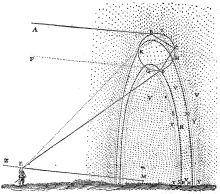
René Descartes' sketch of how chief and secondary rainbows are formed
Descartes' 1637 treatise, Discourse on Method, further advanced this explanation. Knowing that the size of raindrops did non announced to affect the observed rainbow, he experimented with passing rays of calorie-free through a big glass sphere filled with h2o. By measuring the angles that the rays emerged, he concluded that the chief bow was caused by a unmarried internal reflection inside the raindrop and that a secondary bow could be acquired by two internal reflections. He supported this conclusion with a derivation of the law of refraction (after to, but independently of, Snell) and correctly calculated the angles for both bows. His explanation of the colours, however, was based on a mechanical version of the traditional theory that colours were produced by a modification of white light.[76] [77]
Isaac Newton demonstrated that white light was equanimous of the low-cal of all the colours of the rainbow, which a glass prism could split up into the total spectrum of colours, rejecting the theory that the colours were produced past a modification of white light. He also showed that red light is refracted less than bluish calorie-free, which led to the first scientific caption of the major features of the rainbow.[78] Newton's corpuscular theory of light was unable to explain supernumerary rainbows, and a satisfactory explanation was not found until Thomas Young realised that calorie-free behaves as a moving ridge nether certain weather, and tin interfere with itself.
Immature'south work was refined in the 1820s past George Biddell Airy, who explained the dependence of the strength of the colours of the rainbow on the size of the water droplets.[79] Mod physical descriptions of the rainbow are based on Mie handful, piece of work published past Gustav Mie in 1908.[80] Advances in computational methods and optical theory continue to atomic number 82 to a fuller agreement of rainbows. For example, Nussenzveig provides a modern overview.[81]
Experiments

Round bottom flask rainbow demonstration experiment - Johnson 1882
Experiments on the rainbow phenomenon using artificial raindrops, i.e. water-filled spherical flasks, become back at least to Theodoric of Freiberg in the 14th century. Later, also Descartes studied the miracle using a Florence flask. A flask experiment known every bit Florence's rainbow is still often used today equally an imposing and intuitively accessible demonstration experiment of the rainbow phenomenon.[82] [83] [84] It consists in illuminating (with parallel white light) a water-filled spherical flask through a hole in a screen. A rainbow will then appear thrown back / projected on the screen, provided the screen is large enough. Due to the finite wall thickness and the macroscopic graphic symbol of the artificial raindrop, several subtle differences exist as compared to the natural phenomenon,[85] [86] including slightly inverse rainbow angles and a splitting of the rainbow orders.
A very similar experiment consists in using a cylindrical glass vessel filled with water or a solid transparent cylinder and illuminated either parallel to the round base (i.e. calorie-free rays remaining at a fixed meridian while they transit the cylinder)[87] [88] or under an angle to the base of operations. Under these latter weather condition the rainbow angles change relative to the natural phenomenon since the effective index of refraction of water changes (Bravais' index of refraction for inclined rays applies).[85] [86]
Other experiments apply modest liquid drops,[51] [52] see text to a higher place.
Civilization and mythology
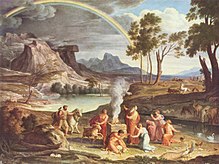
Rainbows occur oftentimes in mythology, and have been used in the arts. Ane of the earliest literary occurrences of a rainbow is in the Book of Genesis affiliate nine, as part of the flood story of Noah, where it is a sign of God'southward covenant to never destroy all life on Earth with a global flood once again. In Norse mythology, the rainbow bridge Bifröst connects the world of men (Midgard) and the realm of the gods (Asgard). Cuchavira was the god of the rainbow for the Muisca in present-twenty-four hours Republic of colombia and when the regular rains on the Bogotá savanna were over, the people thanked him offering gold, snails and small emeralds. Some forms of Tibetan Buddhism or Dzogchen reference a rainbow body.[89] The Irish leprechaun's hugger-mugger hiding place for his pot of gilt is commonly said to be at the terminate of the rainbow. This place is accordingly impossible to reach, because the rainbow is an optical effect which cannot exist approached.
Rainbows announced in heraldry - in heraldry the rainbow proper consists of iv bands of colour (Or, Gules, Vert, Argent) with the ends resting on clouds.[90] Generalised examples in coat of arms include those of the towns of Regen and Pfreimd, both in Bavaria, Germany; and of Bouffémont, France; and of the 69th Infantry Regiment (New York) of the Army National Guard (USA).
Rainbow flags take been used for centuries. It was a symbol of the Cooperative movement in the German language Peasants' War in the 16th century, of peace in Italy, and of gay pride and LGBT social movements since the 1970s. In 1994, Archbishop Desmond Tutu and President Nelson Mandela described newly democratic postal service-apartheid South Africa equally the rainbow nation. The rainbow has also been used in applied science production logos, including the Apple figurer logo. Many political alliances spanning multiple political parties take chosen themselves a "Rainbow Coalition".
Pointing at rainbows has been considered a taboo in many cultures.[91]
Encounter also
- Atmospheric eyes
- Circumzenithal arc
- Circumhorizontal arc
- Iridescent colours in soap bubbles
- Sun domestic dog
- Fog bow
- Moonbow
Notes
- ^ "A careful reading of Newton'south work indicates that the color he called indigo, we would normally call blueish; his blue is and then what we would name blue-green or cyan."[3]
- ^ "Ex quo clarissime apparet, lumina variorum colorum varia esset refrangibilitate : idque eo ordine, ut color ruber omnium minime refrangibilis sit, reliqui autem colores, aureus, flavus, viridis, cæruleus, indicus, violaceus, gradatim & ex ordine magis magisque refrangibiles."[2]
- ^ "approximation obtained by his model was good plenty to allow him to ignore the effects of the glass container."[66]
References
- ^ Masters, Jeff (14 April 2005). "The 360-degree Rainbow". Atmospheric condition Hole-and-corner. The Weather Company. Archived from the original on 29 January 2015.
- ^ a b c Isaac Newton, Optice: Sive de Reflexionibus, Refractionibus, Inflexionibus & Coloribus Lucis Libri Tres, Propositio II, Experimentum Vii, edition 1740
- ^ a b Waldman, Gary (1983). Introduction to Light: The Physics of Light, Vision, and Color (2002 revised ed.). Mineola, New York: Dover Publications. p. 193. ISBN978-0486421186.
- ^ Walklet, Keith S. (2006). "Lunar Rainbows – When to View and How to Photograph a "Moonbow"". The Ansel Adams Gallery. Archived from the original on May 25, 2007. Retrieved 2007-06-07 .
- ^ "Why is the within of a rainbow brighter than the outside heaven?". WeatherQuesting. Archived from the original on May 28, 2013. Retrieved 2013-08-19 .
- ^ "Rainbow – A polarized arch?". Polarization.com. Archived from the original on 2013-09-09. Retrieved 2013-08-19 .
- ^ Burch, Paula E. "All About Hand Dyeing Q&A". Archived from the original on 24 April 2012. Retrieved 27 August 2012. (A number betwixt 36 and 360 is in the order of 100)
- ^ Gage, John (1994). Colour and Significant. Academy of California Press. p. 140. ISBN978-0-520-22611-1.
- ^ Allchin, Douglas. "Newton's Colors". SHiPS Resource Center. Archived from the original on 2014-09-29. Retrieved 2010-10-16 .
- ^ Hutchison, Niels (2004). "Music For Measure: On the 300th Anniversary of Newton'south Opticks". Colour Music. Archived from the original on 2017-01-18. Retrieved 2017-04-07 .
- ^ Newton, Isaac (1704). Opticks.
- ^ "Visible Spectrum Wikipedia Contributors, Wikipedia, The Gratuitous Encyclopedia accessed 11/17/2013 bachelor at: Visible spectrum
- ^ Cowley, Les. "Primary rainbow colours". Atmospheric Optics . Retrieved 27 August 2012.
- ^ Rosch Heider, Eastward. (1972). "Universals in colour naming and memory". Journal of Experimental Psychology. 93 (one): 10–20. doi:ten.1037/h0032606. PMID 5013326.
- ^ Dawkins, Richard (2005). The ancestor's tale: a pilgrimage to the dawn of development.
- ^ Roberson, Debi; Davies, Ian; Davidoff, Jules (September 2000). "Color categories are non universal: Replications and new evidence from a stone-age culture" (PDF). Periodical of Experimental Psychology: General. 129 (3): 369–398. doi:x.1037/0096-3445.129.3.369. PMID 11006906.
- ^ "Virtually Rainbows". Eo.ucar.edu. Archived from the original on 2013-08-18. Retrieved 2013-08-19 .
- ^ Cowley, Les. "Sea Water Rainbow". Atmospheric Optics . Retrieved 2007-06-07 .
- ^ Cowley, Les. "Nil society glow". Atmospheric Eyes. Archived from the original on 2013-01-thirteen. Retrieved 2011-08-08 .
- ^ Betimes (seven Nov 2014). "Why are rainbows curved equally semicircles?". Ask the van. The Board of Trustees at the University of Illinois. Archived from the original on 2 October 2015. Retrieved thirteen April 2015.
- ^ "How to see a whole circle rainbow – EarthSky.org". earthsky.org. Archived from the original on 2013-10-04.
- ^ "USATODAY.com – Await down on the rainbow". usatoday30.usatoday.com.
- ^ Anon (29 March 2004). "Solution, Week 81, Rainbows" (PDF). Harvard University Department of Physics. Archived (PDF) from the original on viii October 2016. Retrieved thirteen June 2016.
- ^ "The colors of the secondary rainbow are reversed from the primary bow, and the secondary bow is twice every bit broad". hyperphysics.phy-astr.gsu.edu . Retrieved 14 Jan 2022.
{{cite web}}: CS1 maint: url-status (link) - ^ "Secondary rainbow". world wide web.atoptics.co.united kingdom.
- ^ See:
- Alexander of Aphrodisias, Commentary on Volume Four of Aristotle's Meteorology (as well known as: Commentary on Book IV of Aristotle'due south De Meteorologica or On Aristotle'due south Meteorology 4), commentary 41.
- Raymond L. Lee and Alistair B. Fraser, The Rainbow Bridge: Rainbows in Art, Myth, and Scientific discipline (Academy Park, Pennsylvania: Pennsylvania State University Printing, 2001), pp. 110–111.
- ^ "Atmospheric Eyes: Twinned rainbows". Atoptics.co.uk. 2002-06-03. Retrieved 2013-08-nineteen .
- ^ See:
- Haußmann, Alexander (February 2015). "Observation, assay, and reconstruction of a twinned rainbow". Applied Optics. 54 (4): B117–B127. Bibcode:2015ApOpt..54B.117H. doi:10.1364/AO.54.00B117. PMID 25967817.
- "Researchers unlock underground of the rare 'twinned rainbow,' " ScienceDaily.com, August 6, 2012. Archived August ix, 2012, at the Wayback Motorcar
- ^ Sadeghi, Iman; Munoz, Adolfo; Laven, Philip; Jarosz, Wojciech; Seron, Francisco; Gutierrez, Diego; Jensen, Henrik Wann (2012). "Physically-based simulation of rainbows" (PDF). ACM Transactions on Graphics. 31: one–12. CiteSeerX10.1.ane.296.3051. doi:10.1145/2077341.2077344. S2CID 6774839.
- ^ "Triple-split rainbow observed and photographed in Japan, August 2012". blog.meteoros.de. 2015-03-12. Archived from the original on 2015-04-02. Retrieved 2015-03-12 .
- ^ "Can you e'er see the whole circle of a rainbow? | World". EarthSky. 2012-12-fifteen. Archived from the original on 2013-10-04. Retrieved 2013-ten-04 .
- ^ Philip Laven (2012-08-04). "Circular rainbows". Philiplaven.com. Archived from the original on 2013-10-05. Retrieved 2013-ten-04 .
- ^ "APOD: 2014 September xxx – A Total Circumvolve Rainbow over Australia". apod.nasa.gov. Archived from the original on 2015-01-25.
- ^ "OPOD – 360° Rainbow". world wide web.atoptics.co.uk.
- ^ "Supernumerary Rainbows". www.atoptics.co.uk.
- ^ "Supernumerary Rainbows and drop size". world wide web.atoptics.co.u.k..
- ^ "Fogbow droplet size event". www.atoptics.co.uk.
- ^ Meet:
- Thomas Young (1804) "Bakerian Lecture: Experiments and calculations relative to physical optics," Philosophical Transactions of the Purple Gild of London 94: 1–sixteen; see peculiarly pp. 8–11.
- Atmospheric Eyes: Supernumerary Rainbows
- ^ Les Cowley (Atmospheric Eyes). "Bows everywhere!". Retrieved xiii Apr 2015.
- ^ Nemiroff, R.; Bonnell, J., eds. (12 September 2007). "Six Rainbows Across Kingdom of norway". Astronomy Picture of the Day. NASA. Retrieved 2007-06-07 .
- ^ "Atmospheric Eyes: Reflection rainbows formation". Atoptics.co.britain. Retrieved 2013-08-nineteen .
- ^ "Dawn Red Rainbows Arizona – OPOD". atoptics.co.uk.
- ^ "Untitled Certificate". world wide web.atoptics.co.united kingdom.
- ^ "third & quaternary order rainbows". world wide web.atoptics.co.united kingdom of great britain and northern ireland.
- ^ Großmann, Michael; Schmidt, Elmar; Haußmann, Alexander (one Oct 2011). "Photographic testify for the third-club rainbow". Applied Optics. 50 (28): F134–F141. Bibcode:2011ApOpt..50F.134G. doi:10.1364/AO.fifty.00F134. ISSN 1559-128X. PMID 22016237. S2CID 796963.
- ^ "Triple Rainbows Be, Photo Bear witness Shows, ScienceDaily.com, Oct. v, 2011". Sciencedaily.com. 2011-x-06. Archived from the original on 2013-10-04. Retrieved 2013-08-19 .
- ^ Theusner, Michael (1 October 2011). "Photographic observation of a natural fourth-order rainbow". Practical Optics. 50 (28): F129–F133. Bibcode:2011ApOpt..50F.129T. doi:10.1364/AO.l.00F129. ISSN 1559-128X. PMID 22016236. S2CID 20238055.
- ^ "Short Sharp Science: First ever image of 4th-social club rainbow". world wide web.newscientist.com. Archived from the original on 2017-07-11.
- ^ "Observations of the quinary rainbow". www.weatherscapes.com. Archived from the original on 2015-01-03.
- ^ Billet, Felix (1868). "Mémoire sur les Dix-neuf premiers arcs-en-ciel de fifty'eau" [Memoir on the first 19 rainbows]. Annales Scientifiques de l'École Normale Supérieure. 1 (v): 67–109. doi:10.24033/asens.43.
- ^ a b Walker, Jearl (1977). "How to create and notice a dozen rainbows in a single drop of h2o". Scientific American. 237 (July): 138–144 + 154. Bibcode:1977SciAm.237a.138W. doi:ten.1038/scientificamerican0777-138. Archived from the original on 2011-08-xiv. Retrieved 2011-08-08 .
- ^ a b J.D. Walker, "Mysteries of rainbows, notably their rare supernumerary arcs," Sci. Am. 242(6), 174–184 (1980).
- ^ Ng, P. H.; Tse, M. Y.; Lee, Due west. K. (1998). "Ascertainment of loftier-order rainbows formed by a pendant drib". Journal of the Optical Society of America B. fifteen (eleven): 2782. Bibcode:1998JOSAB..15.2782N. doi:10.1364/JOSAB.15.002782.
- ^ "Moonbow – Lunar Rainbow". world wide web.atoptics.co.uk. Archived from the original on 2008-04-21. Retrieved 2015-06-28 .
- ^ See:
- Atmospheric Optics: Fogbow
- James C. McConnel (1890) "The theory of fog-bows," Philosophical Magazine, series 5, 29 (181): 453–461.
- ^ Les Cowley. Observing Halos – Getting Started Atmospheric Optics, accessed 3 December 2013.
- ^ "Friday Dark – Sleetbow". johncohn.org . Retrieved 2021-02-ten .
- ^ "Circumzenithal Arc". www.atoptics.co.great britain.
- ^ Cowley, Les. "Circumhorizontal arc". Atmospheric Optics . Retrieved 2007-04-22 .
- ^ Science@NASA. "Rainbows on Titan". Archived from the original on 2008-09-21. Retrieved 2008-11-25 .
- ^ Cowley, Les. "Sea Water Rainbow". Atmospheric Optics . Retrieved 2016-eleven-ten .
- ^ Cowley, Les. "Glass Bead Bows". Atmospheric Optics . Retrieved 2016-11-10 .
- ^ "The Internet Classics Annal – Meteorology past Aristotle". classics.mit.edu. Archived from the original on 2014-02-18.
- ^ Raymond L. Lee; Alistair B. Fraser (2001). The rainbow bridge: rainbows in art, myth, and science. Penn State Press. p. 109. ISBN978-0-271-01977-2.
- ^ Seneca, Lucius Anneus (1 Apr 2014). Delphi Complete Works of Seneca the Younger (Illustrated). Vol. Book I (Delphi Ancient Classics Book 27 ed.). Delphi Classics.
- ^ a b c O'Connor, J.J.; Robertson, E.F. (November 1999). "Kamal al-Din Abu'fifty Hasan Muhammad Al-Farisi". MacTutor History of Mathematics archive, University of St Andrews. Archived from the original on 2007-03-25. Retrieved 2007-06-07 .
- ^ Nader El-Bizri 'Ibn al-Haytham et le problème de la couleur', Oriens-Occidens: Cahiers du heart d'histoire des sciences et des philosophies arabes et médiévales, C.N.R.S. 7 (2009), pp. 201–226.
- ^ Carl Benjamin Boyer (1954). "Robert Grosseteste on the Rainbow". Osiris. 11: 247–258. doi:ten.1086/368581. S2CID 145639868.
- ^ Raymond L. Lee; Alistair B. Fraser (2001). The rainbow span: rainbows in art, myth, and science. Penn State Printing. pp. 141–144. ISBN978-0-271-01977-2.
- ^ Sivin, Nathan (1995). Science in Aboriginal China: Researches and Reflections Brookfield, Vermont: VARIORUM. Iii: Ashgate Publishing. p. 24.
- ^ Dong, Paul (2000). China's Major Mysteries: Paranormal Phenomena and the Unexplained in the People'south Republic. San Francisco: Cathay Books and Periodicals, Inc. p. 72. ISBN978-0-8351-2676-2.
- ^ Davidson, Michael W. (August one, 2003). "Roger Bacon (1214–1294)". Florida Country University. Archived from the original on August xxx, 2006. Retrieved 2006-08-10 .
- ^ Raymond Fifty. Lee; Alistair B. Fraser (2001). The rainbow bridge: rainbows in art, myth, and scientific discipline. p. 156. ISBN978-0-271-01977-2.
- ^ Lindberg, David C (Summer 1966). "Roger Bacon's Theory of the Rainbow: Progress or Regress?". Isis. 57 (ii): 235. doi:10.1086/350116. S2CID 170749000.
- ^ Theodoric of Freiberg (c. 1304–1310) De iride et radialibus impressionibus (On the rainbow and the impressions of radiance).
- ^ Boyer, Carl B. (1952). "Descartes and the Radius of the Rainbow". Isis. 43 (ii): 95–98. doi:10.1086/349399. S2CID 145493641.
- ^ Gedzelman, Stanley David (1989). "Did Kepler's Supplement to Witelo Inspire Descartes' Theory of the Rainbow?". Bulletin of the American Meteorological Society. 70 (7): 750–751. Bibcode:1989BAMS...70..750G. doi:10.1175/1520-0477(1989)070<0750:DKSTWI>2.0.CO;two. ISSN 1520-0477.
- ^ O'Connor, J.J.; Robertson, E.F. (January 2000). "Sir Isaac Newton". University of St. Andrews. Archived from the original on 2007-06-10. Retrieved 2007-06-nineteen .
- ^ See:
- Airy, Thou. B. (1838). "On the intensity of light in the neighbourhood of a caustic". Transactions of the Cambridge Philosophical Gild. 6 (3): 379–403. Bibcode:1838TCaPS...6..379A.
- One thousand. B. Airy (1849) "Supplement to a paper, "On the intensity of light in the neighbourhood of a caustic," " Transactions of the Cambridge Philosophical Guild eight: 595–600.
- ^ G. Mie (1908) "Beiträge zur Optik trüber Medien, speziell kolloidaler Metallösungen" Archived 2012-03-02 at the Wayback Machine (Contributions to the optics of turbid media, especially of colloidal metallic solutions), Annalen der Physik, quaternary serial, 25 (3): 377–445.
- ^ Nussenzveig, H. Moyses (1977). "The Theory of the Rainbow". Scientific American. 236 (4): 116. Bibcode:1977SciAm.236d.116N. doi:10.1038/scientificamerican0477-116.
- ^ "Florence's Rainbow", Harvard Natural Sciences Lecture Demonstrations, link Archived 2017-01-08 at the Wayback Auto
- ^ "Rainbow: Refraction of white calorie-free by a liquid sphere.", U.C. Berkeley Physics Lecture Demonstrations, link Archived 2017-01-08 at the Wayback Machine
- ^ "The Rainbow,"J.B. Calvert, link Archived 2016-05-24 at the Wayback Machine, retrieved: x/01/2016
- ^ a b "Revisiting the circular bottom flask rainbow experiment.", One thousand. Selmke and S. Selmke, arXiv, link Archived 2017-01-08 at the Wayback Machine
- ^ a b Pictures and Raytracings nether "Alexander'due south dark band (or bright band?)", K. Selmke, link Archived 2017-01-08 at the Wayback Auto
- ^ G. Casini and A. Covello, "The "rainbow" in the drop," Am. J. Phys. lxxx(11), 1027–1034 (2012).
- ^ "Principal and Secondary Bow of a Rainbow", U.C. Berkeley Physics Lecture Demonstrations, link Archived 2017-01-08 at the Wayback Machine
- ^ Ray, Reginald (2001). Underground of the Vajra Globe: The Tantric Buddhism of Tibet. Shambhala Publications. p. 323. ISBN9781570627729.
- ^ "Rainbow", mistholme.com
- ^ Blust, Robert (June 2021). "Pointing, Rainbows, and the Archæology of Mind". Anthropos. 116: 145–161. doi:10.5771/0257-9774-2021-1-145. S2CID 236605041. Retrieved 29 November 2021.
Further reading
- Greenler, Robert (1980). Rainbows, Halos, and Glories. Cambridge University Press. ISBN978-0-19-521833-half dozen.
- Lee, Raymond 50. & Alastair B. Fraser (2001). The Rainbow Bridge: Rainbows in Art, Myth and Scientific discipline. New York: Pennsylvania Land Academy Press and SPIE Printing. ISBN978-0-271-01977-ii.
- Lynch, David One thousand.; Livingston, William (2001). Color and Light in Nature (2nd ed.). Cambridge University Printing. ISBN978-0-521-77504-5.
- Minnaert, Marcel G.J.; Lynch, David K.; Livingston, William (1993). Light and Color in the Outdoors. Springer-Verlag. ISBN978-0-387-97935-9.
- Minnaert, Marcel G.J.; Lynch, David G.; Livingston, William (1973). The Nature of Light and Colour in the Open up Air. Dover Publications. ISBN978-0-486-20196-ii.
- Naylor, John; Lynch, David K.; Livingston, William (2002). Out of the Blueish: A 24-Hr Skywatcher's Guide. Cambridge Academy Press. ISBN978-0-521-80925-two.
- Boyer, Carl B. (1987). The Rainbow, From Myth to Mathematics. Princeton Academy Press. ISBN978-0-691-08457-2.
- Graham, Lanier F., ed. (1976). The Rainbow Volume. Berkeley, California: Shambhala Publications and The Fine Arts Museums of San Francisco. (Large format handbook for the Summertime 1976 exhibition The Rainbow Fine art Show which took place primarily at the De Immature Museum but as well at other museums. The book is divided into 7 sections, each coloured a unlike colour of the rainbow.)
- De Rico, Ul (1978). The Rainbow Goblins. Thames & Hudson. ISBN978-0-500-27759-one.
External links
 | Wikiquote has quotations related to: Rainbows |
 | Wikimedia Eatables has media related to Rainbow. |
- The Mathematics of Rainbows, article from the American mathematical lodge
- Interactive simulation of lite refraction in a driblet (java applet)
- Rainbow seen through infrared filter and through ultraviolet filter
- Atmospheric Optics website by Les Cowley – Description of multiple types of bows, including: "bows that cross, cherry-red bows, twinned bows, coloured fringes, dark bands, spokes", etc.
- Merrifield, Michael. "Rainbows". Sixty Symbols. Brady Haran for the Academy of Nottingham.
- Creating Circular and Double Rainbows! – video caption of nuts, shown artificial rainbow at night, 2nd rainbow and circular one.
Knowing What a Rainbow Looks Like Because You Have Seen a Rainbow Is an Example of a Concept
Source: https://en.wikipedia.org/wiki/Rainbow

Post a Comment for "Knowing What a Rainbow Looks Like Because You Have Seen a Rainbow Is an Example of a Concept"